

Aditya Birla Education Academy focuses on providing educators with learning opportunities to pursue their ambitions and boost their career growth.
Diploma in Early Childhood Education
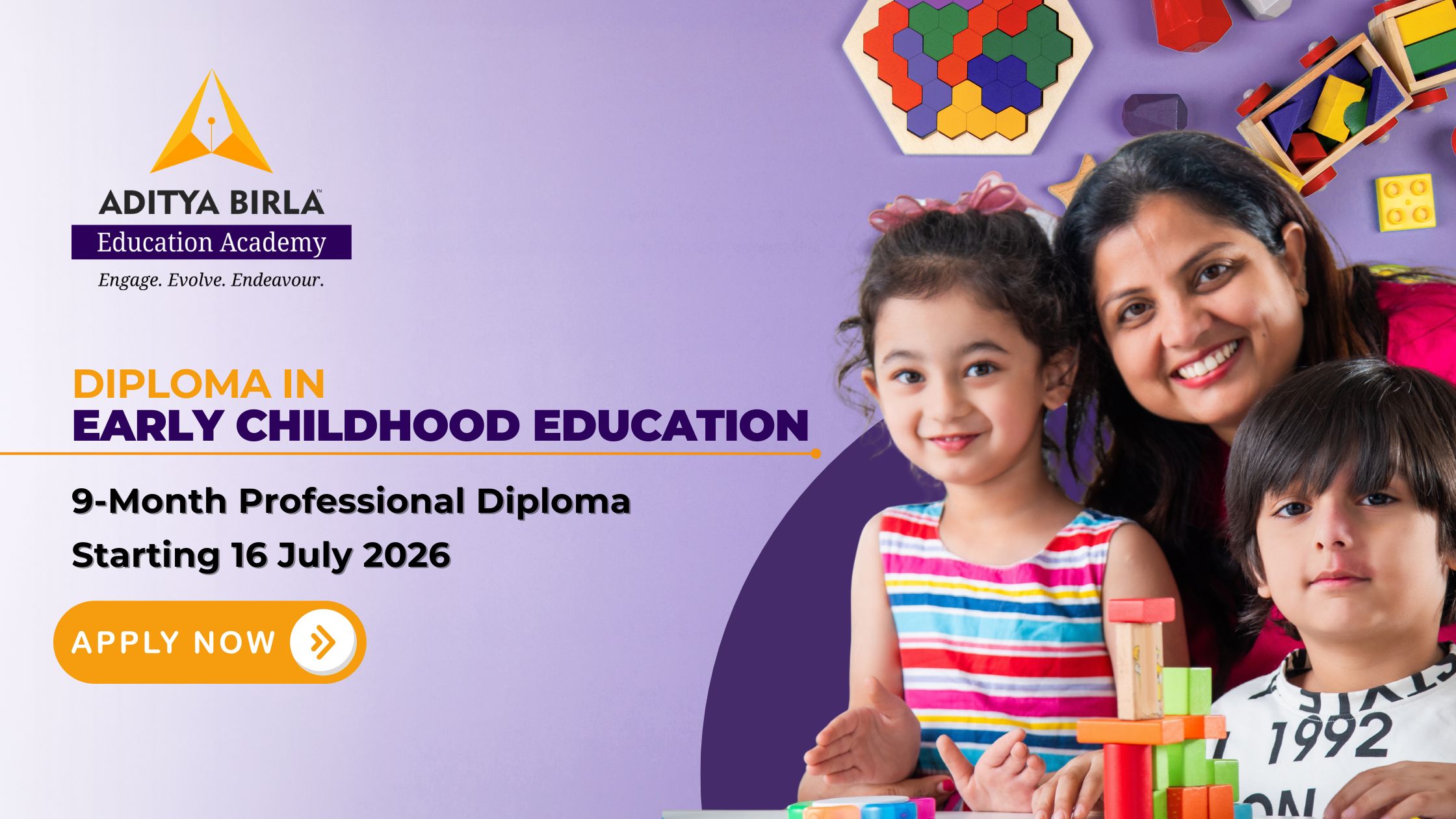

This diploma follows a rigorous 336-hour learning framework that integrates guided instruction, applied practice, and supervised internship.
The programme strengthens pedagogical clarity while building leadership capability through structured progression and real classroom integration.
Programme Snapshot
- Duration: 9 Months (Hybrid)
- Total Learning Hours: 336
- Guided Contact Hours: 216
- Supervised Internship: 120 Hours
- 16th July 2026
Who Should Apply
- Experienced & aspiring educators
- Early Years practitioners seeking leadership development
- Teachers strengthening curriculum and assessment expertise
- Schools investing in structured teacher development
-
Course Modules
1. Foundations of Early Childhood Education
Contents: philosophy & history of ECCE; NEP/NCF Foundational Stage principles (holistic, play-based, activity-based); key features of Finnish, Singapore, IB and Cambridge early years approaches; rights of the child and ethical practice.
2. Child Development & Learning Theories
Contents: cognitive, socio-emotional, language, motor development; attachment & temperament; developmental milestones; Vygotsky/Bruner/Piaget/Modern brain research; observation for learning. Emphasis on individual differences and formative support.
3. Curriculum Design & Pedagogy for Early Years
Contents: designing play-based, inquiry-led, and integrated thematic units; mapping learning outcomes (NEP/NCF, PYP, NEL, Cambridge); lesson planning for 3–8 yrs; transition to Grade 1 (upward continuity). Includes model unit plans showing crosswalks between NEP/NCF, IB PYP, Singapore NEL, Finnish practices, and Cambridge Early Years.
4. Language & Early Literacy (multilingual)
Contents: language acquisition in multilingual classrooms, oral language environments, phonics vs whole language (science of reading basics), emergent literacy practices, story, songs, dramatic play, home-language strengths and language planning for multilingual Indian contexts. Best practices from IB & Cambridge for language exploration.
5. Early Numeracy & STEAM for Young Children
Contents: number sense, spatial reasoning, patterns, measurement, early problem-solving, hands-on STEAM experiences, loose parts, investigations. Aligns with Singapore’s strong emphasis on sequenced learning and Finland’s play-rich experiential approach.
6. Assessment, Observation & Documentation
Contents: observational tools (running records, anecdotal notes, learning stories), developmental checklists, formative assessment, portfolios, parent reports, documenting learning for IB PYP style transdisciplinary work, and how to avoid high-stakes formal testing at the foundational stage.
7. Inclusive Education & Supporting Diverse Learners
Contents: identifying and supporting special needs, differentiated instruction, scaffolding, multilingual classrooms, GIRFEC-style inclusion (principles), referral pathways, classroom adaptations, collaboration with specialists and families. Finnish and IB approaches to individualized planning highlighted.
8. Health, Safety, Nutrition & Wellbeing
Contents: child protection, first aid basics for early years, infection control, nutrition for 3–8 yrs, sleep & routines, outdoor learning safety, mental-health-friendly classroom practices. Includes policy templates and school safety audits.
9. Environment, Materials & Indoor/Outdoor Classroom Design
Contents: designing responsive indoor/outdoor learning environments, provocations, loose parts, learning corners, Montessori/Forest school influences, materials selection on a budget, sustainable practices (recycling, natural materials). Finnish emphasis on outdoor ECEC is discussed.
10. Family & Community Engagement; Culture & Diversity
Contents: family partnerships, home-visits (where applicable), community resources, culturally sustaining pedagogy, partnering with caregivers for assessment and transitions, engagement strategies aligned with NEP emphasis on parents/communities.
11. Technology, Media & AI in ECCE (ethical use)
Contents: appropriate tech use, digital portfolios, using apps to support learning (not replace play), AI tools for teacher planning and differentiation (ethics & limits).
12. Professionalism, Leadership & Ethics
Contents: professional standards, reflective practice, teacher evaluation, continuing professional development (CPD) pathways, leadership & team work in early years settings, aligning with CBSE/NEP teacher professionalization drives.
13. Micro-teaching, Practice Labs & Demonstration Teaching
Contents: trainees design and deliver mini-lessons (peer feedback), simulated classroom management, portfolio assembly, video-review sessions. Offline labs used for hands-on materials and role plays.
-
SUPERVISED INTERNSHIP - 120 HOURS (Required)
Structured mentored placement during the final trimester.
Internship Requirements
- 40+ hours of supervised teaching with documented lesson plans and reflections
- 20+ structured observation records across age groups
- 8–10 developmental assessment portfolios with progress documentation
- Family engagement task with reflective submission
- Inclusive practice case study with mentor feedback
- Classroom environment redesign project with before/after documentation
- Final reflective practicum report (2,000–3,000 words or multimedia portfolio)
- Professional conduct log aligned with child-safety and ethical standards
Need More Information?
Write to us at abea.info@abet.co.in
Call us at +91 9321283966 / +91 9769919697
Write your review
-
1. Who is this diploma designed for?
This programme is designed for aspiring and experienced Early Years educators, including those beginning their journey as well as professionals with 3–4+ years of classroom practice who are seeking structured professional growth and leadership development.
2. What is the duration of the programme?
The diploma runs for 9 months and follows a structured academic calendar.
3. How many total learning hours are included?
The programme includes 336 total learning hours, comprising 216 guided contact hours and a 120-hour supervised internship.
4. What is the format of delivery?
The programme follows a blended format with weekly online sessions, monthly offline practice labs, and a supervised internship during the final trimester.
5. Is the internship mandatory?
Yes. The 120-hour supervised internship is a required component of the diploma and must be successfully completed and evaluated.
6. How is the programme assessed?
Assessment includes:
- Continuous assessment (40%)
- Internship & practicum evaluation (40%)
- Capstone project (20%)
7. What certification is awarded upon completion?
Participants who successfully meet all programme requirements are awarded the Diploma in Early Childhood Education by Aditya Birla Education Academy.
8. When does the next cohort commence?
Admissions are currently open. The upcoming cohort will commence in 16th July 2026.
9. Is placement support available?
Graduates receive career guidance and placement support aligned with institutional networks and partner schools.
10. What is the scope of early childhood education Diploma?
An Early Childhood Education Diploma opens up a wide range of career opportunities in the education sector. The course equips students with the skills and knowledge needed to teach and care for young children during their foundational learning years. After completing the diploma, candidates can work as preschool teachers, nursery teachers, daycare coordinators, curriculum planners, or childcare providers in schools, preschools, and learning centers. The demand for qualified early childhood educators is steadily increasing due to the growing awareness of quality early education and child development.
11. Is dece equal to ntt?
DECE (Diploma in Early Childhood Education) and NTT (Nursery Teacher Training) are similar courses that focus on preparing candidates to teach young children. Both programs cover child psychology, classroom management, teaching methodologies, and early learning techniques. However, the course structure, duration, and certification may vary depending on the institute or university offering the program. In many cases, DECE and NTT are considered equivalent for preschool and nursery teaching roles.

Chat Now
